

The British Museum in London has been accused of using historically inaccurate and misleading descriptions in its Ancient Levant and Egypt galleries.
UK Lawyers for Israel (UKLFI) has written to the Director of the British Museum, Dr Nicholas Cullinan OBE, raising serious concerns regarding the anachronistic use of the term Palestine. UKLFI highlighted the repeated use of the term “Palestine” to describe the region now comprising Israel and surrounding areas during historical periods when that name did not exist. UKLFI pointed out that this anachronistic terminology distorts the historical record and obscures the history of Israel and the Jewish people.
UKLFI identified a number of maps displayed in the Museum’s Egypt galleries, covering periods from approximately 1795 BC to 332 BC, which label the area of modern-day Israel as “Palestine”. UKLFI explained that during these periods the region was known as Canaan and later was politically divided into distinct entities, including the Kingdoms of Israel and Judah, Philistia, and Phoenicia.
UKLFI also raised concerns about explanatory text describing the Phoenicians, which refers to the Israelites as having occupied “most of Palestine” in the first millennium BC. According to UKLFI, this wording wrongly applies a much later geographical term to an earlier historical context.
In addition, UKLFI understands that figures such as King David, the prophetess Deborah, and Judah Maccabee are described in the Museum’s collections as originating from “Palestine”, despite being firmly rooted in the historical Kingdoms of Israel and Judah.
The letter explains that the earliest known use of the term “Palestine” appears in the writings of Herodotus in the 5th century BC, where it referred only to a coastal strip inhabited by the Philistines. The name was later imposed by the Roman Emperor Hadrian after the Bar Kokhba revolt in around 135 AD, when the province of Judea was renamed “Syria Palaestina” in an effort to minimise Jewish connection to the land.
UKLFI argues that retroactively applying the name “Palestine” across thousands of years creates a false impression of historical continuity and erases the emergence and existence of Jewish kingdoms and Jewish national identity in the region.
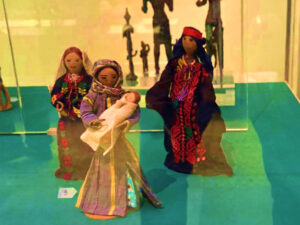
Further concerns were raised about the placement of mid-20th-century dolls described as wearing “Palestinian traditional dress” within the Museum’s Ancient Levant gallery. UKLFI says that displaying modern artefacts in this context risks implying an uninterrupted cultural lineage that is not historically accurate.
UKLFI pointed out that these curatorial choices are not only misleading for the general public but also deeply troubling for Jewish and Israeli visitors. UKLFI states that the terminology used may create a hostile or offensive environment and could amount to harassment under the Equality Act 2010, which prohibits harassment related to protected characteristics including race, religion and philosophical belief.
UKLFI has called on the British Museum to conduct a comprehensive review of its maps and descriptions and to amend them so that regions are referred to by the historically accurate names applicable to the specific period in question, such as Canaan, the Levant, the Kingdoms of Israel and Judah, Judea, Samaria, or the Galilee.
A spokesperson for UKLFI, commented:
“Museums play a vital role in educating the public. When dealing with highly sensitive and politicised history, accuracy is essential. The repeated use of historically inaccurate terminology risks misleading visitors and marginalising Jewish history and identity.”