

UK Lawyers for Israel (UKLFI) welcomes Lord Mann’s review into antisemitism in the NHS and the Government’s acceptance of its recommendations.
The review’s conclusion that Jewish staff and patients have experienced hostility, exclusion and discrimination within parts of the NHS is consistent with the evidence that UKLFI has encountered in its own work, particularly since the Hamas atrocities of 7 October 2023.
Over the past two and a half years UKLFI has made or assisted numerous complaints concerning healthcare professionals, NHS institutions and healthcare settings where allegations of antisemitism, support for terrorist organisations, or conduct undermining confidence among Jewish patients and staff have arisen.
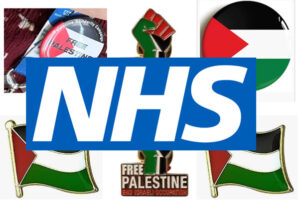
A pattern identified in UKLFI’s casework has been the widespread display of pro-Palestinian political symbols by healthcare staff in patient-facing environments. Since October 2023, UKLFI has received numerous complaints from Jewish patients and staff who reported feeling intimidated, distressed or unwelcome when confronted with political insignia associated with the anti-Israel movement while receiving treatment or attending work.
One of the most significant examples involved Barts Health NHS Trust (Barts), which operates St Bartholomew’s Hospital, the Royal London Hospital, Whipps Cross Hospital, Newham Hospital and Mile End Hospital.
UKLFI raised concerns about multiple incidents at these hospitals involving staff wearing “Free Palestine” badges, Palestinian flag pins and other political insignia while treating patients.
Incidents included an elderly Jewish patient at St Bartholomew’s Hospital who was distressed by staff wearing Palestinian flag pins, a patient at Whipps Cross Hospital who complained after seeing a member of staff wearing a Palestinian football shirt, and reports of staff displaying large “Free Palestine” badges on hospital lanyards.
Following complaints submitted by UKLFI, Barts reviewed its dress code and subsequently introduced a policy prohibiting staff from displaying political symbols in the workplace.
UKLFI also made representations concerning Imperial College Healthcare NHS Trust, following reports from patients and staff at St Mary’s Hospital in Paddington. Among the incidents reported were allegations that the head nurse of one ward wore a “Free Palestine” lanyard, that the head nurse of Accident and Emergency wore a Palestine flag badge, that a site nurse practitioner displayed a Palestine flag badge, that doctors wore watermelon badges on their lanyards, and that a junior doctor displayed “Free Palestine” slogans on a phone case while at work. Following UKLFI’s intervention, the Trust confirmed that it was reviewing its uniform and appearance policy.
UKLFI has also raised concerns regarding political displays within hospital premises themselves. In 2023, UKLFI complained to Chelsea and Westminster Hospital NHS Foundation Trust about artwork displayed in the children’s outpatient department at Chelsea and Westminster Hospital and accompanying explanations which incorporated anti-Israel political messaging. Jewish patients and parents reported feeling uncomfortable and excluded by the display, particularly in a setting intended for children and families from all backgrounds.
Following complaints, the artwork was removed. The case highlighted the importance of maintaining healthcare environments that are politically neutral and welcoming to all patients, regardless of their religion, ethnicity or views on international conflicts.
UKLFI has also dealt with complaints concerning the display of watermelon symbols, which have increasingly been used as a substitute for the Palestinian flag. Jewish patients have reported that such symbols, particularly when displayed alongside other political messaging, create anxiety and concern about whether healthcare environments remain politically neutral. Similar concerns have arisen regarding Palestine-themed lanyards, badges, clothing and digital imagery displayed by healthcare staff.
The issue is not whether individual healthcare professionals are entitled to hold political opinions. Rather, it concerns the appropriateness of displaying partisan political symbols while providing healthcare to vulnerable patients. UKLFI has consistently argued that hospitals and clinics should remain politically neutral environments in which patients can have confidence that they will be treated equally regardless of their nationality, ethnicity, religion or political beliefs.
UKLFI has also dealt with dozens of cases concerning alleged antisemitic social media activity of medical staff. Among the most significant cases has been that of Dr Rahmeh Aladwan, a trainee trauma and orthopaedic surgeon.
UKLFI submitted complaints and evidence to the General Medical Council (GMC) concerning her social media activity that included Holocaust analogies, references to “Jewish supremacy”, Hamas-related material and other content that many Jewish patients and healthcare professionals regarded as antisemitic and extremist.
Following further investigations, the Medical Practitioners Tribunal Service imposed an interim suspension on Dr Aladwan in November 2025, citing concerns about public confidence in the profession.
UKLFI has also pursued complaints concerning Dr Ellen Kriesels, a consultant paediatrician at Whittington Hospital. Following a GMC referral, an Interim Orders Tribunal imposed a nine-month suspension while investigations into allegations of antisemitic conduct continued. The tribunal heard evidence relating to protest activity and social media material that had prompted serious concerns among members of the Jewish community.
UKLFI has also been approached by Jewish healthcare workers who reported feeling intimidated, marginalised or unable to express their Jewish identity openly within their workplaces. We have seen evidence of political activism entering healthcare environments in ways that undermine the neutrality, professionalism and inclusiveness that patients are entitled to expect. In some cases, Jewish staff have reported feeling unsupported by management when raising concerns about antisemitism.
The pattern emerging from these cases is strikingly similar to the picture described by Lord Mann. What might once have been dismissed as isolated incidents now appears to be a wider institutional problem affecting both Jewish staff and Jewish patients. The review’s findings that Jewish healthcare workers often feel unable to report concerns and that antisemitism has not always been recognised or addressed appropriately echo experiences repeatedly reported to UKLFI.
The concerns identified by Lord Mann are not confined to the NHS. Since 7 October 2023, UKLFI has also dealt with complaints concerning healthcare staff wearing pro-Palestine badges and other political insignia in private hospitals, including the Harley Street Clinic and Harborne Hospital Birmingham, both part of HCA Healthcare UK.
Jewish patients complained that the display of such political messaging in clinical settings caused them anxiety and undermined their confidence that healthcare environments would remain politically neutral and welcoming to all patients.
The fact that such concerns have arisen in both NHS and private healthcare settings demonstrates that the challenge identified by Lord Mann extends beyond any single institution and requires a consistent response across the healthcare sector as a whole.
We therefore welcome Lord Mann’s recommendation that antisemitism be treated with the seriousness accorded to all forms of racism and that stronger mechanisms be established for reporting, investigating and addressing incidents.
W+e also welcome recommendations aimed at improving accountability, ensuring that complaints are properly investigated and resolved, and maintaining the neutrality of healthcare environments for the benefit of all patients and staff.
UKLFI has long argued that antisemitism should be addressed with the same determination as every other form of racism and discrimination. The experiences reported to us demonstrate that this has not always happened. Lord Mann’s report provides an important opportunity to rectify that failure.