

UK Lawyers for Israel (UKLFI) has challenged an Edinburgh bookshop over its decision to cancel a poetry event after receiving complaints that its Jewish organiser had performed “Zionist/racist” poems at other venues.
UKLFI has written to Typewronger Books on behalf of Jewish poet Tracey S. Rosenberg, arguing that the cancellation of her Dead Poets’ Slam was likely to constitute unlawful discrimination under the Equality Act 2010.
The event, scheduled for 2 December 2026, was a light-hearted poetry competition in which performers would impersonate deceased poets and recite their work. Ms Rosenberg was due to host the evening in the character of Dorothy Parker. The event had nothing to do with Israel or Gaza.
Typewronger initially welcomed the proposal, describing it as “an excellent idea, and very us!” The event was advertised on Eventbrite, tickets were booked and performers had begun signing up.
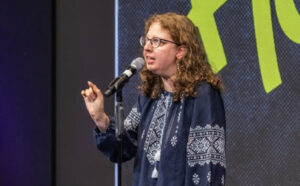
photo credit: Chris Scott
However, on 19 October, the bookshop contacted Ms Rosenberg claiming it had received complaints about “potential safeguarding issues”. These included allegations that she had performed “various Zionist/racist poems” at other Edinburgh open mic events and accused other poets of antisemitism for using the phrase “Free Palestine”.
In its email to Ms Rosenberg, Typewronger stated that it did not want to create the impression that it supported Israel and declared: “Free Palestine is very much the opinion of those who work here.”
The bookshop then asked Ms Rosenberg to clarify her own position. When she requested a telephone conversation, Typewronger insisted on communicating by email, stating: “I hope our position is unambiguous, please let me know yours.”
Ms Rosenberg replied that she was unsure what was expected of herHowever, Typewronger refused to engage further with Ms Rosenberg, instead choosing to cancel the event less that two hours after first raising the allegations.
The cancellation appears to have been prompted by the Zionist beliefs attributed to Ms Rosenberg, rather than by anything connected with the planned event.
Ms Rosenberg identified three poems on subjects relating to Israel and her Jewish identity that she performed at spoken word events. These related to the 7 October terrorist attacks, antisemitism in Britain and anti-Israel protests. None of them was racist.
UKLFI argues that Zionism, understood as belief in the Jewish people’s right to self-determination in their homeland, is capable of protection as a philosophical belief under the Equality Act 2010. The Act also protects Jewish ethnicity and religion.
UKLFI has asked Typewronger to explain who decided to cancel the event, disclose the complaints and other evidence relied upon, acknowledge the alleged discrimination and apologise to Ms Rosenberg.
It has also called for safeguards to ensure that future organisers and performers are not required to declare their political views on Israel or other unrelated issues as a condition of participation.
Ms Rosenberg commented: “I’m sad that an independent bookshop I’ve admired and supported for years chose to discriminate against me based on unfounded rumors, and shut down the opportunity for a dialogue that might have allowed us to move forward. As a social enterprise, they must be keenly aware that discrimination violates human rights and dignity. I’m also disappointed that one of my MSPs, Q Manivannan (Scottish Greens), a longstanding member of the Scottish spoken scene, should be on record as standing up to discrimination in the transgender community but dismisses discrimination against Jews as ‘political differences’. On the other hand, the support I’ve found from the Jewish community – including many others who have been cancelled – has confirmed that standing up to discrimination is the best thing I can do for myself and for others.”
A UKLFI spokesperson said:
“It is alarming that a Jewish poet’s event could be cancelled simply because someone complained that her poetry was ‘Zionist’. She was apparently expected to demonstrate agreement with the bookshop’s political position on Israel, even though her event had nothing to do with the conflict.
“People are entitled to disagree about Israel, but they are not entitled to exclude others from public events because of their Jewish identity or protected beliefs. We believe this cancellation crossed the line into unlawful discrimination.”